At first glance, an industrial air conditioner and a domestic air conditioner appear to perform the same basic function: lowering indoor temperature. However, the engineering requirements behind them can be very different.
A domestic air conditioner is generally designed around residential comfort, moderate heat loads, limited operating hours, and relatively controlled indoor conditions. Industrial air conditioning must often deal with large spaces, continuous operation, machinery-generated heat, high ambient temperatures, dust, open doors, and demanding airflow requirements.
ASHRAE specifically identifies industrial air conditioning as a specialized field covering manufacturing plants, processing facilities, laboratories, and power plants, where HVAC may need to control not only temperature but also humidity, air movement, air quality, cleanliness, and process conditions.
Therefore, replacing an industrial system with a domestic unit simply because both are “air conditioners” can result in insufficient cooling, poor air distribution, higher maintenance requirements, or shortened equipment life.
Domestic air conditioners are primarily intended to create comfortable indoor conditions in homes, apartments, bedrooms, living rooms, and similar spaces.
The cooling load in a residential room is usually influenced by:
Occupants
Lighting
Appliances
Solar radiation
Outdoor temperature
Building insulation
Window area
Residential air conditioners are consequently optimized for relatively predictable comfort-cooling requirements.
Their compact size, quiet operation, convenient controls, and relatively simple installation make them appropriate for homes.
A domestic air conditioner generally emphasizes:
Indoor comfort
Low noise
Compact dimensions
Aesthetic appearance
Simple temperature adjustment
Moderate airflow
Residential operating schedules
ASHRAE treats room air conditioners as a distinct equipment category with specific capacity and efficiency classifications, illustrating the different design framework used for residential and room-level cooling equipment.
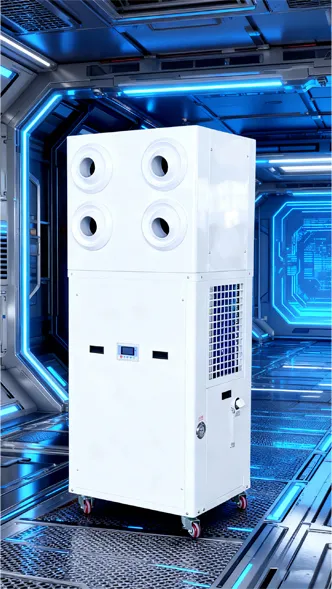
Industrial air conditioning starts with a different question.
Instead of asking, “How can one room be kept comfortable?”, engineers may need to ask, “How can a large production environment remain within an acceptable temperature range despite continuous internal heat generation?”
Factories can contain motors, furnaces, compressors, welding equipment, injection molding machines, production lines, lighting systems, and hundreds of workers.
These heat sources can produce a substantially higher cooling load than a typical residential room.
PQZILI describes industrial air conditioners as systems intended for workshops, warehouses, manufacturing facilities, commercial kitchens, electrical rooms, and other demanding environments. Its product range includes louvered, jet-type, kitchen, wall-mounted, and portable industrial air conditioners.
Industrial HVAC design may need to account for:
Machinery heat
Process heat
Large indoor volume
High ceilings
Frequent door opening
Outdoor air infiltration
Dust and contaminants
Long operating periods
High ambient temperatures
Concentrated worker zones
ASHRAE notes that industrial HVAC design should address the process environment as well as personnel health, safety, and comfort.
Factor | Industrial Air Conditioning | Domestic Air Conditioner |
Primary objective | Industrial cooling and environmental control | Residential comfort |
Typical space | Factory, warehouse, workshop | Bedroom, living room, apartment |
Heat load | Often high and variable | Usually moderate |
Operating schedule | Potentially continuous | Usually intermittent |
Airflow | High-volume or directional | Room-level distribution |
Construction | Heavy-duty industrial design | Compact residential design |
Air distribution | May require long-distance airflow | Short-distance room airflow |
Maintenance environment | Potentially dusty or demanding | Relatively clean |
Installation | Application-specific | Standardized |
Cooling capacity | Small to very large | Generally smaller |
Typical controls | Application-oriented | User-oriented |
The distinction is not simply about “more powerful” equipment. Industrial systems are designed around the environment in which they operate.
One of the most visible differences between industrial and domestic equipment is available capacity.
A 5hp air conditioner, 7 hp air conditioner, or 10hp air conditioner can be considered when a facility has a much larger cooling requirement than a typical residential room.
PQZILI's industrial portfolio includes 5HP, 7HP, and 10HP models in different configurations. The product range includes Top AirJet units, vertical shutter models, and louvered systems.
However, horsepower should never be the only selection criterion.
The required capacity depends on:
Building dimensions
Internal heat generation
Outdoor design temperature
Insulation
Number of workers
Door-opening frequency
Required indoor temperature
Airflow distribution
A 7 hp air conditioner may therefore be appropriate for one workshop but unsuitable for another workshop of similar size if the internal heat loads are substantially different.
Cooling capacity alone does not guarantee good results.
Imagine a factory with a 10-meter-high ceiling and a production line extending 50 meters across the building. A domestic split air conditioner may produce sufficiently cold air near its indoor unit but fail to distribute that air effectively throughout the workspace.
This is where specialized industrial configurations become important.
A louver air conditioner is useful when airflow needs to be directed toward specific areas.
PQZILI's louvered industrial air conditioner range is designed to provide adjustable airflow distribution. This configuration can be useful in workshops, offices connected to industrial areas, and spaces where cooling needs vary between zones.
An adjustable louvers air conditioner allows operators to modify airflow direction instead of relying on a fixed discharge pattern.
A jet air conditioner is designed around directional airflow and longer-distance cooling.
PQZILI identifies its jet-type industrial units as suitable for long-distance directional cooling in workshops and production areas. The range includes 5HP, 7HP, 10HP, 12HP, and 15HP models.
The term jet air airconditioner is sometimes used in product searches to describe this type of directional industrial cooling equipment.
The difference is important: a domestic system generally focuses on distributing conditioned air within a relatively small room, while a jet-type industrial system can be selected when air needs to travel farther.
Industrial equipment often operates in conditions that would be unsuitable for ordinary household equipment.
Factories may expose equipment to:
Dust
Oil mist
High temperatures
Continuous vibration
Frequent operation
Accidental impact
Corrosive environments
PQZILI states that its industrial air conditioners use robust metal housings, corrosion-resistant materials, and designs intended to facilitate maintenance.
This emphasis on durability is one reason buyers should evaluate industrial equipment according to the environment rather than selecting a domestic model solely because its purchase price is lower.
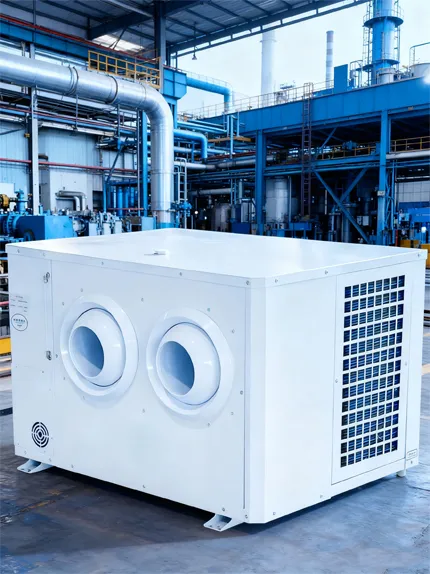
Domestic AC installation is relatively standardized. A typical residential installation may involve an indoor unit, outdoor unit, refrigerant piping, electrical connection, and condensate drainage.
Industrial systems can require considerably more planning.
Engineers may need to consider:
Mounting height
Airflow path
Equipment access
Electrical requirements
Condensate drainage
Outdoor-unit placement
Maintenance clearance
Production-line interference
ASHRAE also emphasizes energy conservation in industrial HVAC through measures such as insulation, ventilation, and heat recovery because industrial facilities can involve substantial air volumes and energy consumption.
Technically, a domestic air conditioner can cool a small enclosed industrial office or control room. It is not necessarily appropriate for cooling an entire production area.
The problem occurs when the equipment is expected to handle conditions beyond its original design.
For example, a small domestic system may struggle with:
Continuous high heat generation
Large open doors
High ceilings
Large production areas
High outdoor temperatures
Heavy dust exposure
Long-distance airflow requirements
OSHA distinguishes air cooling from ventilation and notes that air conditioning removes heat from air, while increased airflow can help workers cool themselves under suitable conditions.
This reinforces the importance of selecting the cooling strategy according to the actual workplace conditions.
When comparing suppliers, buyers should look beyond cooling capacity.
A reliable industrial air conditioner manufacturer should be able to provide:
Multiple cooling capacities
Different airflow configurations
Application-specific recommendations
Customized voltage options where required
Installation guidance
Spare parts support
Maintenance information
Technical documentation
PQZILI offers different industrial configurations, including louvered, jet-type, kitchen, wall-mounted, and portable systems, allowing buyers to select equipment according to space and cooling requirements.
The answer depends on the environment.
A domestic air conditioner is generally the logical choice for bedrooms, apartments, homes, and other conventional comfort-cooling spaces.
Industrial air conditioning becomes more appropriate when the building contains substantial heat sources, large open areas, high ceilings, demanding operating schedules, or specific airflow requirements.
For example:
Residential room: domestic split AC
Small enclosed office inside a factory: domestic or commercial AC may be sufficient
Production workshop: industrial AC
Large warehouse: industrial jet-type AC may be appropriate
Localized production zone: louver air conditioner
High-temperature industrial area: specialized industrial cooling
Large facility: multiple industrial units or a centralized solution
The objective should not be to buy the largest available unit. Instead, the system should be matched to the building's heat load, airflow pattern, operating conditions, and maintenance requirements.
Domestic air conditioning is primarily designed for residential comfort, while industrial air conditioning is designed for larger spaces, higher heat loads, demanding operating environments, and specialized airflow requirements.
A 5hp air conditioner can be suitable for certain smaller industrial spaces. The final choice should be based on heat load, space size, ambient temperature, and required airflow.
A 7 hp air conditioner can be considered when a workshop or commercial space requires more cooling capacity than a smaller industrial unit can provide. A proper cooling-load calculation should determine the final capacity.
Yes, a 10hp air conditioner can be used for larger industrial cooling applications, but suitability depends on the actual cooling load and airflow requirements rather than horsepower alone.
A louver air conditioner uses adjustable air outlets to control the direction of discharged air. This can be useful when different areas of an industrial space require targeted cooling.
It can be advantageous in factories where airflow needs to be directed toward particular workstations or production areas. The appropriate configuration depends on building layout and heat distribution.
A louver window air conditioner generally refers to a window-mounted residential or room air-conditioning configuration with louvered sides or airflow openings. It should not be confused with a heavy-duty industrial louvered air conditioner.
A jet air conditioner is designed to deliver directional airflow over a longer distance. This makes the configuration useful for some large workshops, warehouses, and production environments.
“Jet air airconditioner” is an alternative search phrase commonly used to describe a jet-type air-conditioning unit. The intended equipment is generally a system that provides strong directional airflow for larger spaces.
1. THE DIFFERENCE BETWEEN INDUSTRIAL AIR CONDITIONING AND INDUSTRIAL CHILLER?
2. ADVANTAGES AND DISADVANTAGES OF INDUSTRIAL AIR CONDITIONERS
 +86-178-1894-1386
  taylor_jiao@pqzili.com