Choosing between an industrial fan and an industrial air conditioner is not simply a matter of comparing airflow or equipment price. These two systems solve different cooling problems. A fan moves air to improve ventilation and increase the body's ability to release heat, while an air conditioner removes heat from the air and delivers actual cooling.
For factories, warehouses, workshops, kitchens, production lines, and equipment rooms, the right choice depends on temperature, humidity, heat load, airflow requirements, and whether the goal is worker comfort or temperature control.
According to ASHRAE, industrial ventilation is primarily used to control excess heat, odors, and contaminants, while mechanical systems can also incorporate heating or cooling equipment.
The fundamental difference is how each system handles heat.
An industrial fan circulates or exhausts air. It does not normally reduce the actual temperature of the air. Instead, increased air movement can improve evaporative and convective cooling for workers.
The U.S. Occupational Safety and Health Administration explains that increasing airflow with fans can help workers stay cooler, but the moving air does not actually cool the air itself.
An air conditioner, by contrast, uses a refrigeration system to remove heat from indoor air and discharge cooler air back into the space. This makes it more suitable when a factory needs to reduce ambient temperature rather than simply increase air movement.
Industrial fans are mainly used for:
General ventilation
Heat and odor removal
Air circulation
Exhaust ventilation
Worker spot cooling
Improving air movement in large spaces
ASHRAE defines a fan as a device that creates airflow and notes its use for ventilation, cooling, heating, exhaust, and other air-transport applications.
An industrial air conditioner is designed for more controlled cooling. PQZILI describes its industrial air conditioners as systems designed for workshops, warehouses, commercial kitchens, electrical rooms, manufacturing facilities, and other demanding environments.
Its product range includes louvered, jet-type, kitchen, wall-mounted, and portable industrial air conditioners.
Factor | Industrial Fan | Industrial Air Conditioner |
Main function | Moves or exhausts air | Removes heat and cools air |
Actual air-temperature reduction | Limited/No | Yes |
Ventilation | Excellent | Depends on system design |
Humidity control | Limited | Possible |
Worker spot cooling | Excellent | Excellent |
Large-area cooling | Useful with ventilation | More effective for controlled cooling |
Heat-load management | Limited | Stronger |
Initial cost | Usually lower | Usually higher |
Energy consumption | Generally lower | Generally higher |
Temperature control | Limited | Much better |
Best applications | Ventilation and air movement | Temperature-controlled cooling |
The U.S. Department of Energy also identifies fans as important components of industrial systems and recommends measures such as variable-speed control, proper airflow, and operation near the best efficiency point.
An industrial fan is usually the better choice when the primary problem is poor ventilation rather than excessive indoor temperature.
For example, a large warehouse may have acceptable outdoor temperatures but stagnant indoor air caused by machinery, workers, or insufficient air exchange. Installing exhaust and circulation fans can move hot air away from work areas.
Fans can also be useful around localized heat sources. However, their effectiveness depends heavily on environmental conditions.
If the surrounding air is already extremely hot, simply moving that air may provide limited relief.
The CDC/NIOSH recommends increasing air velocity as one engineering control for reducing workplace heat stress.
An industrial air conditioner is preferable when the objective is to actively lower indoor temperature or maintain a more stable thermal environment.
It is particularly suitable for:
Manufacturing workshops
Electronics production areas
Warehouses with temperature-sensitive products
Electrical rooms
Commercial kitchens
Production lines
Equipment rooms
Temporary cooling zones
High-temperature industrial workplaces
PQZILI's product range demonstrates why capacity and configuration matter. Its industrial air conditioner series includes 5HP air conditioner, 7HP air conditioner, and 10HP air conditioner models, together with different airflow configurations.
For example, a 5HP air conditioner may be considered for a relatively localized industrial cooling requirement, while a 7HP air conditioner or 10HP air conditioner may be more appropriate where the cooling load and space size are greater. Final selection should always be based on the actual heat load, room dimensions, ambient temperature, insulation, and required indoor conditions rather than horsepower alone.
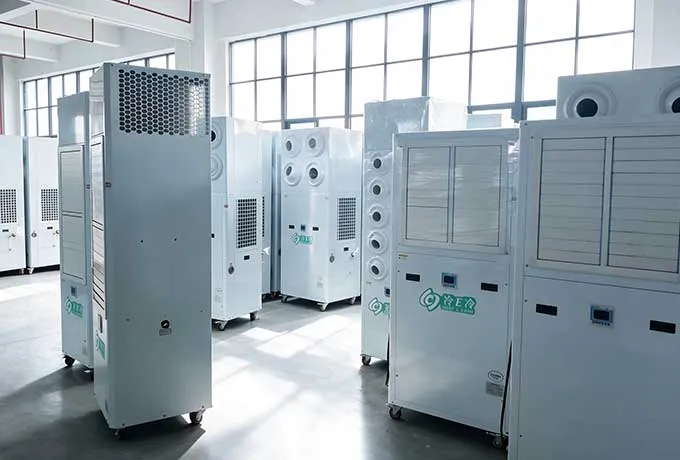
Air distribution is just as important as cooling capacity in an industrial environment.
A louver air conditioner or louvered industrial air conditioner can direct cooled air toward specific working zones. This can be especially useful in factories where workers or machines are concentrated in different areas.
PQZILI's 5HP louvered industrial air conditioner is designed to provide adjustable airflow distribution, while its jet-type models are intended for long-distance directional cooling.
An adjustable louvers air conditioner can therefore provide more flexibility than a fixed-direction system.
It is important not to confuse an industrial louvered unit with a residential louver window air conditioner. Industrial systems are designed for demanding environments, higher airflow requirements, continuous operation, and more robust construction.
Yes. In many factories, using both systems can be more effective than choosing only one.
A typical strategy is:
Use exhaust fans to remove contaminated or excessively hot air.
Use circulation fans to distribute air.
Install industrial air conditioners in areas requiring active cooling.
Use directional or louvered airflow to target workers or heat-producing zones.
Adjust operation according to production schedules and outdoor conditions.
ASHRAE notes that industrial ventilation systems can combine fans, filtration, heating or cooling equipment, ductwork, and air diffusers to create suitable workplace conditions.
For large factories, this combined approach can prevent an air conditioner from carrying the entire ventilation load.
Before purchasing industrial air conditioners for sale, evaluate the following factors:
Consider machinery, motors, lighting, workers, production processes, solar gain, and heat released by equipment.
A large open warehouse may require multiple units or a combination of ventilation and cooling rather than a single air conditioner.
High outdoor temperatures can significantly affect air-conditioning performance. Industrial applications may require equipment specifically designed for high-ambient conditions.
For long production lines or concentrated workstations, jet-type or adjustable-louver systems may provide better coverage than a fixed outlet.
If cooling operates continuously, compressor efficiency, maintenance access, controls, and system reliability become especially important.
A qualified industrial air conditioner manufacturer can help determine cooling capacity, configuration, airflow direction, installation method, and operating requirements.
There is no universal winner.
Choose an industrial fan when you mainly need ventilation, exhaust, air circulation, or economical worker cooling.
Choose an industrial air conditioner when you need actual temperature reduction, better environmental control, or targeted cooling in high-temperature industrial areas.
For many factories, the best solution is a combination of both. Fans handle ventilation and air movement, while industrial air conditioners provide active cooling where temperature reduction is essential.
For buyers comparing industrial air conditioners for sale, PQZILI offers multiple configurations and capacities, including 5HP, 7HP, and 10HP models, allowing the cooling system to be matched to different industrial applications.
It depends on the purpose. A fan is better for ventilation and air movement, while an air conditioner is better when actual temperature reduction is required.
Normally, no. A fan moves air and can make people feel cooler, but it does not remove heat from the room like an air conditioner.
A 5HP air conditioner can be suitable for localized or medium-scale industrial cooling, depending on the actual cooling load and installation environment.
A 7HP air conditioner may be appropriate when the required cooling capacity is greater than a smaller unit can provide. Room size, heat generation, ambient temperature, and airflow requirements should all be considered.
A 10HP air conditioner can be considered for larger or higher-heat-load industrial applications. However, horsepower alone should not determine the final selection.
A louver air conditioner uses adjustable airflow openings to help direct cooled air toward specific areas. This is useful for industrial spaces with defined work zones.
Yes. Fans can provide ventilation and air circulation while air conditioners provide active cooling. Combining the two can be an effective strategy for many industrial facilities.
 +86-178-1894-1386
  taylor_jiao@pqzili.com