Industrial air conditioning is essential for factories, workshops, warehouses, commercial kitchens and other large spaces where standard residential AC systems may not provide sufficient airflow or durability. Selecting the right capacity and configuration is important for maintaining a stable indoor environment while controlling energy consumption and maintenance costs.
PengqiangZili offers industrial air-conditioning solutions in louvered, jet-type, kitchen and wall-mounted configurations. Its current range includes 5HP, 7HP, 10HP, 12HP and 15HP models, providing different options for industrial and commercial cooling applications.
For buyers comparing a jet air aircon for sale, the key question is not simply how many horsepower the unit has. The application, heat load, airflow pattern, space layout and operating conditions should all be considered.
An industrial air conditioner is designed to provide cooling for demanding environments such as production facilities, warehouses, workshops and commercial spaces. Compared with conventional residential units, industrial systems typically emphasize stronger airflow, durable construction, continuous operation and adaptability to large or challenging environments.
According to the U.S. Department of Energy, commercial and industrial buildings use different categories of air-cooled, water-cooled and other air-conditioning equipment for space conditioning. Energy performance should therefore be considered alongside cooling capacity when selecting commercial equipment.
PQZILI describes its industrial air conditioners as suitable for factories, workshops, warehouses, offices, kitchens and other large commercial environments. Its product range includes adjustable louvered systems, long-range jet-type systems and kitchen models designed for high-temperature and grease-intensive environments.
Horsepower is commonly used as a convenient way to distinguish industrial AC models, but it should not be treated as the only selection criterion. Actual cooling performance depends on the equipment design, ambient conditions, airflow, room characteristics and heat sources.
Model Size | Typical Application | Main Advantage | Selection Consideration |
5HP | Workshops, kitchens, smaller commercial areas | Compact industrial cooling | Suitable heat-load calculation |
7HP | Workshops, warehouses, larger commercial areas | Stronger airflow and coverage | Space layout and airflow direction |
10HP | Large workshops, warehouses, industrial areas | Higher cooling capacity | Heat load and installation space |
12–15HP | Large industrial spaces | High-capacity cooling | Professional system design |
PQZILI currently lists 5HP Air Conditioner Top AirJet Type, 7HP Air Conditioner Top AirJet Type, and 10HP Air Conditioner Top AirJet Type, as well as corresponding louvered, vertical shutter and kitchen models.
A 5hp air conditioner can be considered when the cooling requirement is moderate but the environment is more demanding than a typical office or residential room.
A 5hp aircon may be suitable for workshops, smaller production areas, commercial spaces or kitchens, depending on the actual heat load. PQZILI lists both 5HP louvered and 5HP AirJet configurations, giving buyers a choice between broader adjustable airflow and stronger directional airflow.
The important point is that 5HP should not automatically be matched to a particular floor area. Equipment, workers, lighting, outdoor temperature and ventilation can significantly affect the required cooling capacity.
A 7 hp air conditioner provides a higher-capacity option for spaces that require stronger cooling than a 5HP unit can reasonably provide.
A 7 hp aircon can be considered for workshops, warehouses, production areas and other large spaces where airflow needs to reach a wider working area. PQZILI offers several 7HP configurations, including a 7HP vertical model, 7HP vertical shutter type, 7HP top AirJet type and 7HP hanging jet type.
This variety is useful because two spaces with similar floor areas may still require different air-distribution designs.
A 10hp air conditioner is intended for applications requiring greater cooling output and stronger overall air distribution.
PQZILI lists both a 10HP vertical shutter model and a 10HP top AirJet model. Its jet-type industrial air conditioners are designed for powerful, long-range airflow and are positioned for high-rise buildings, warehouses and expansive workshops.
For a large production facility, selecting a 10HP unit may be more appropriate than installing several smaller units, but the final decision should be based on engineering calculations, installation constraints and required airflow.
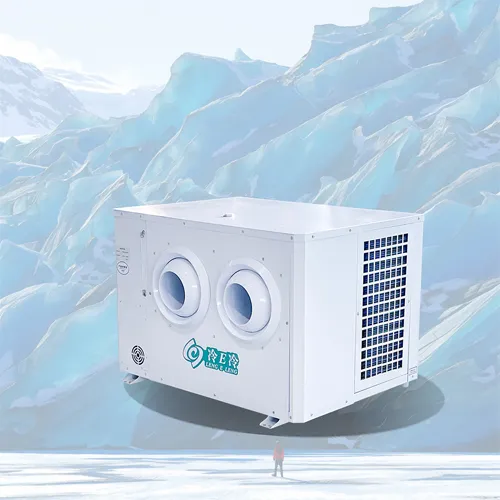
A jet air aircon for sale is worth considering when the primary challenge is not only cooling capacity but also delivering air over a long distance.
PQZILI states that its jet-type industrial air conditioners provide powerful and long-range airflow and are suitable for high-rise buildings, warehouses and expansive workshops. The product range includes 5HP, 7HP, 10HP, 12HP and 15HP top AirJet models.
Jet-type systems can be particularly useful in spaces with high ceilings or long production areas where conventional airflow may not distribute cooled air effectively.
The choice between jet-type and louvered equipment depends largely on airflow requirements.
Feature | Jet-Type AC | Louvered AC |
Airflow | Powerful and long-range | Broad and adjustable |
Best for | High ceilings and large spaces | Factories and workshops |
Air direction | Designed for long-distance delivery | Adjustable outlets |
Typical models | 5HP–15HP | 5HP, 7HP, 10HP and others |
Main consideration | Distance and airflow velocity | Coverage and direction |
PQZILI describes its louvered models as featuring adjustable air outlets, robust airflow and broad cooling capabilities, making them suitable for factories, workshops and large commercial locations.
Commercial kitchens present a different cooling challenge from ordinary workplaces. Cooking appliances generate substantial sensible heat, moisture and airborne contaminants, while exhaust systems remove large quantities of air.
ASHRAE explains that commercial kitchen ventilation involves an integrated system of cooling, replacement air and exhaust. Its design process considers heat and moisture loads, airflow requirements and the relationship between exhaust and replacement air.
Therefore, an ac for kitchen restaurant should not be selected according to room size alone. Cooking equipment, hood exhaust, occupancy, outdoor air and operating schedules all influence the cooling requirement.
PQZILI specifically offers 2HP, 3HP and 5HP kitchen air conditioners. The manufacturer describes these systems as designed for high-temperature, grease-intensive environments and emphasizes strong airflow, efficient cooling and relatively simple maintenance.
Laser equipment requires another type of temperature-management solution. Laser processing systems can generate significant heat during operation, and dedicated cooling equipment may be necessary to maintain stable operating conditions.
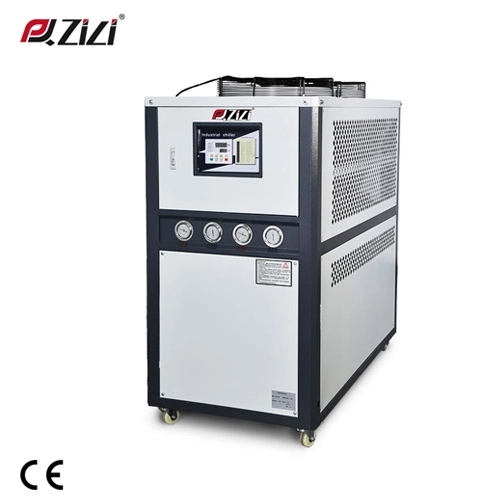
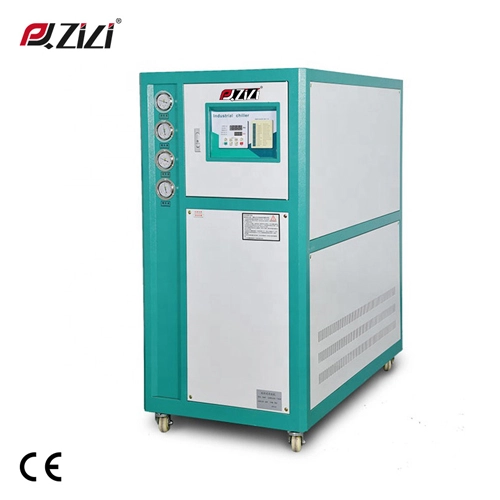
PQZILI lists dedicated laser-cooled chillers separately from its industrial air conditioners, with models including 0.6L, 0.8L, 1L, 1.2L and 1.5L configurations. Its website identifies laser applications as part of its industrial chiller portfolio.
This distinction is important: laser coolers are generally process-cooling equipment rather than simply room air conditioners. If the objective is to cool a laser source, laser chiller equipment should be evaluated according to the laser system's heat load, coolant flow and required temperature stability.
Before choosing an industrial air conditioner, evaluate the following factors:
1. Cooling load: Estimate heat generated by equipment, people, lighting and outdoor conditions.
2. Building height: High ceilings may require long-range jet airflow.
3. Air distribution: Determine whether broad or directional airflow is more suitable.
4. Operating environment: Kitchens and industrial workshops may require more durable construction.
5. Ventilation: Account for exhaust and replacement-air requirements.
6. Energy efficiency: Compare equipment efficiency and expected operating hours.
7. Maintenance: Consider filter cleaning, accessibility and service requirements.
8. Installation: Confirm available space and outdoor-unit requirements.
DOE notes that energy efficiency standards and test procedures apply to commercial air-conditioning equipment, reinforcing the importance of evaluating efficiency in addition to nominal cooling capacity.
.webp "2hp-kitchen-air-conditioner_20251028160339 (1).webp")
PengqiangZili provides multiple industrial air-conditioning configurations rather than relying on a single design. Its current portfolio includes louvered, jet-type, kitchen and wall-mounted industrial air conditioners.
The manufacturer also states that its industrial air conditioners use high-efficiency compressors and optimized airflow design, while models offer voltage adjustment, metal housings and corrosion-resistant materials for demanding environments.
This range allows buyers to compare different configurations according to airflow requirements, installation conditions and application type.
A 7HP model generally provides greater cooling capacity than a 5HP model, but the correct choice depends on the actual heat load, space configuration and operating conditions.
It can be suitable for some warehouses, particularly when combined with an appropriate airflow design. However, ceiling height, building insulation, heat sources and ventilation should be assessed first.
Jet-type air conditioners are useful when cooled air needs to travel a relatively long distance, such as in large workshops, warehouses or high-ceiling spaces.
A 10HP model may be appropriate for larger industrial spaces, but the required capacity should be confirmed through a cooling-load calculation rather than floor area alone.
A dedicated kitchen air conditioner can be more appropriate because commercial kitchens experience high temperatures, grease and substantial ventilation requirements. The cooling system should also be coordinated with the kitchen exhaust design.
No. Laser coolers are generally process-cooling systems designed to remove heat from laser equipment, while industrial air conditioners primarily condition the surrounding air.
Yes. PQZILI lists several 5HP and 7HP configurations, including AirJet, louvered, vertical shutter and hanging jet-type models.
Choosing an industrial air conditioner requires more than selecting the largest horsepower available. For restaurants and commercial kitchens, an ac for kitchen restaurant should be selected together with the ventilation and exhaust strategy. For laser-processing equipment, dedicated laser coolers or laser chillers may be more appropriate than room air conditioning.
With 5HP, 7HP, 10HP and larger configurations, together with louvered, jet-type, kitchen and wall-mounted designs, PengqiangZili provides industrial cooling options for factories, warehouses, workshops, kitchens and other demanding environments.
 +86-178-1894-1386
  taylor_jiao@pqzili.com